Plant to love this week: Wisteria
Curtains of lilac, a scent like nostalgia itself.
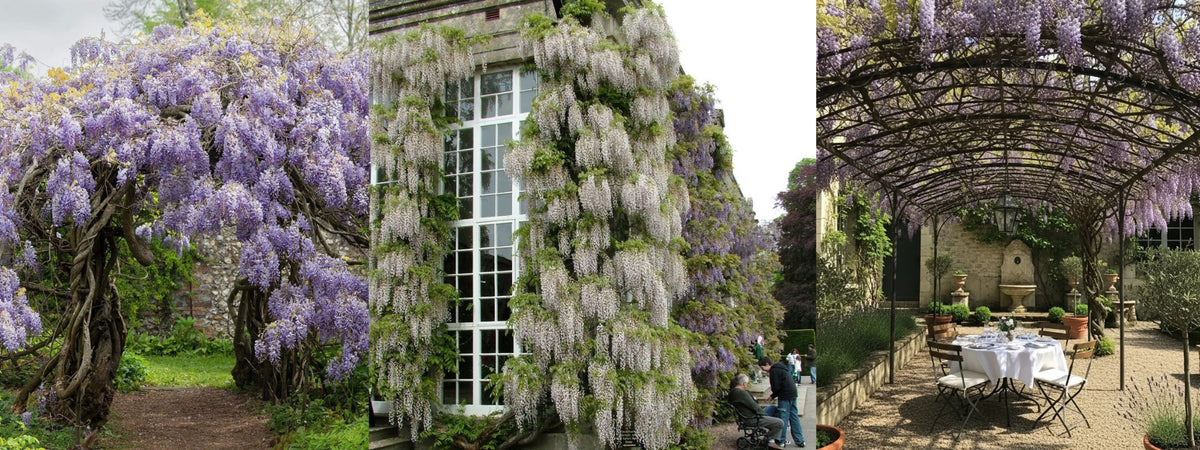
There is something so romantic about wisteria. Perhaps it's the way those long, cascading flowers drape themselves over an old timber arbour, or how their perfume catches you quite unexpectedly on a spring afternoon. Whatever the reason, a wisteria in full flower has a remarkable ability to make people stop, look up and linger a little longer.
PRUNE WITH LE SAC'S WOODEN + STEEL SECATEURS
And who could blame them?
With its generous clusters of lilac, violet or white blooms, the wisteria plant brings a certain charm to the garden. It is the sort of climber that looks as though it has been growing there for generations, whether it has or not.
When to plant wisteria
Autumn and winter, while the plant is dormant, are generally good times to get wisteria into the ground.
Planting during these cooler months gives the roots an opportunity to settle before the vigorous growth of spring begins.
If you're wondering how to plant wisteria, begin by choosing your position carefully. Wisteria is a vigorous, long-lived climber, and once established, it is not particularly keen on being moved.

Give it a sunny position, preferably with at least six hours of direct sunlight, and well-drained soil. A sturdy support is essential, as mature wisteria develops remarkably heavy, woody stems.
One of our favourite wisteria planting tips is to think well beyond the first few years. That little plant may look quite innocent now, but given time, it will need considerable room to stretch.
When is wisteria at its best?
Spring, without question.
The wisteria season is one of those fleeting garden spectacles worth waiting for. Before the foliage has fully unfurled, great pendulous clusters of flowers begin appearing, often in such abundance that the structure beneath them almost disappears.

Depending on the variety and local climate, flowering generally occurs from early to late spring.
And then there is the fragrance. Sweet, heady and wonderfully familiar, particularly on a warm afternoon.
Where does wisteria grow?
Wisteria can be grown across a surprisingly broad range of Australian climates, from subtropical regions to the colder countryside.
It generally flowers most generously where it receives plenty of sunshine and, for many varieties, a sufficiently cool winter. In warmer regions, choosing a variety suited to the local climate makes all the difference.

How we love to use it in the garden
Up and over anything, an arbour, a walkway, veranda posts, up a wall etc…
There are few garden pleasures quite like walking beneath a canopy of wisteria in spring, with flowers hanging overhead and their fragrance lingering in the air.
But do keep it firmly in hand. Wisteria needs to be tamed and managed, otherwise it can take over.

PRUNE WITH LE SAC'S WOODEN + STEEL SECATEURS
Wisteria is a vigorous grower, and its twisting stems can become troublesome around gutters, roofing and delicate structures. Train it deliberately, give it a substantial framework and never let it wander unchecked across the roof.
And here's something worth remembering: prune twice a year, once after flowering in summer and again in winter. Regular pruning helps encourage flowering and keeps that exuberant growth under control.
Wisteria asks for patience, a little discipline and a firm hand with the secateurs.
Come spring, you'll understand why gardeners are so willing to oblige.